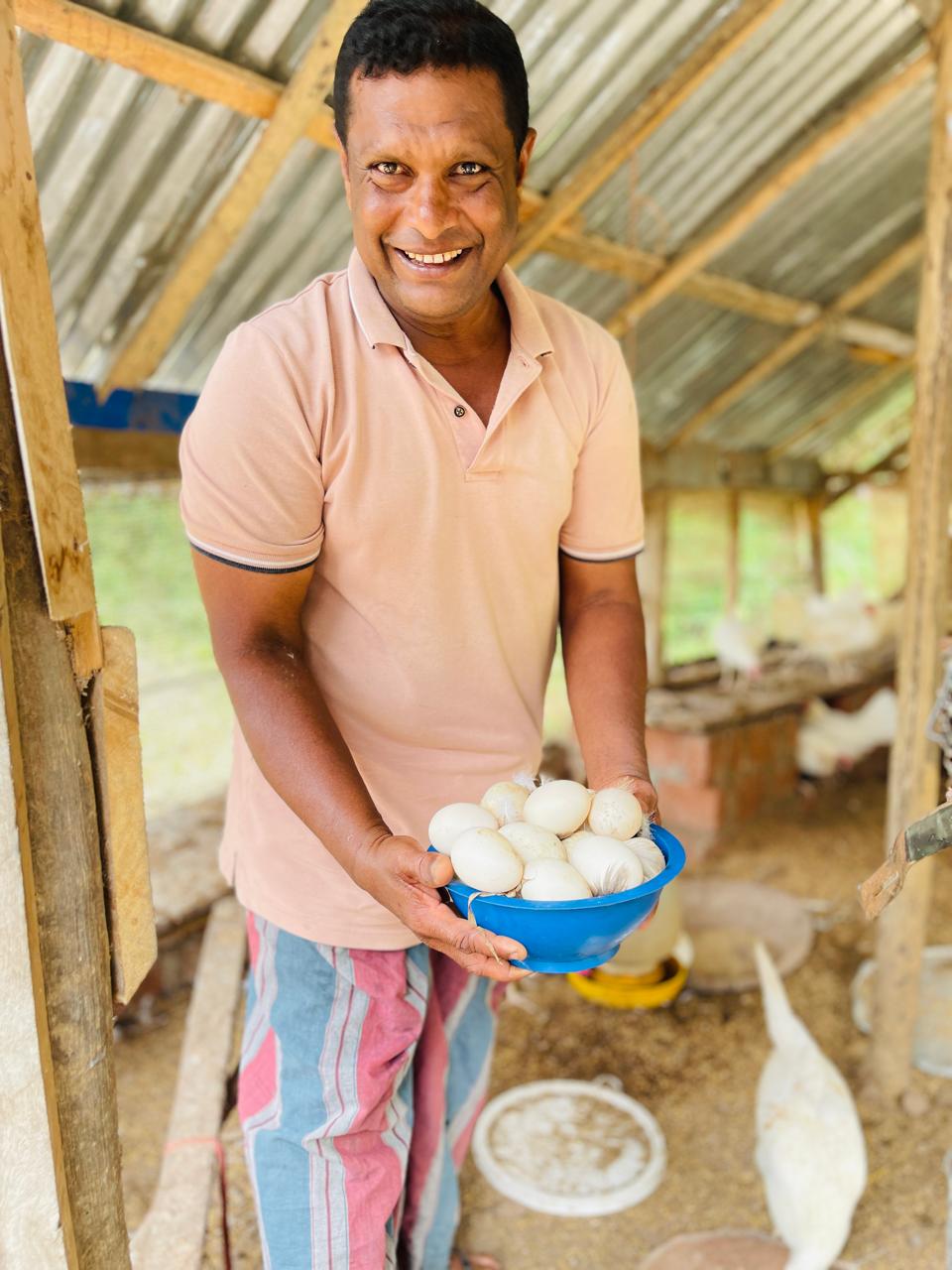
From Struggle to Strength: Nilantha’s Journey in Poultry Farming
In the quiet village of Galgamuwa in the Kurunegala District, Nilantha, a dedicated farmer, once faced the reality of rural hardship. With just a small flock of chickens and limited income, his dream of growing a sustainable poultry business felt far out of reach. Every day was a struggle to provide for his family while battling the challenges of small-scale farming.
That struggle began to shift when support arrived through the Sri Lanka Red Cross Society’s (SLRCS) Livelihood Development Initiative, implemented in partnership with the International Federation of Red Cross and Red Crescent Societies (IFRC). As part of this initiative, over 2,000 vulnerable families including Nilantha received LKR 75,000 in conditional cash grants, along with hands-on guidance to help build and implement practical business plans.
With this support, Nilantha built a new chicken hut capable of housing up to 300 chickens marking a significant leap from where he started. His momentum grew further when he was selected to receive an incubator through the Climate Resilient Integrated Water Management Project (CRIWMP) a tool that transformed his poultry operation.
Today, Nilantha’s smallholding has grown. He earns a steady income not only by selling eggs but also by hatching and selling chicks to nearby farmers.
“I am grateful for what I received,” says Nilantha. “It helped me expand my business. I never imagined I’d come this far.”
But the journey hasn’t been without challenges. Poultry farming comes with its own risks. “Chickens often get sick, and diseases spread fast,” he explained. “And with the frequent power cuts in our area, the incubator sometimes shuts down. When that happens, the chicks inside don’t survive.”
Still, Nilantha remains hopeful. He’s proud of how far he has come and of the new life he’s built for himself and his family.
“Now, other farmers visit me to buy chicks,” he shared. “I earn from that as well as from selling eggs.”
Nilantha’s story is a powerful reminder of how targeted, community-based support can turn hardship into opportunity. It is a testament to resilience, local innovation, and the lasting impact of humanitarian assistance in rural Sri Lanka.